hotel
Human beings must be forced to ask themselves questions
Artists of Litografskaya 30 art studio Alisa Gots, Nina Savenko and Taras Kobliuk talk about heavy stones, light thoughts, black colour and white day, about fundamental lithography
(click on image to view more)
How did you start working together?
Alisa: We studied together and when we were in the 4th year we caught sight of a lithography studio.
Taras: When I started working as a laboratory assistant, I got a proposal to do lithography. I didn’t know what it was and agreed. Nina and Alisa joined me later on. So we have been working together since 2013: that’s when we created a community on Facebook and that was the beginning of Litografskaya 30 widely known in private circles.
Nina: We were very happy to have three hundred subscribers! We have mastered this technique, and we had to develop it.
This technique is not popular. Weren’t you afraid?
Alisa: We couldn’t find materials for a long time and were afraid we wouldn’t find them at all. We were into engraving for a long time.
Taras: Yes, at first we mastered all types of non-stone lithography – on cardboard, polyester, aluminium. We have been working with stones only during the last two years.
Nina: There was no fear at first because we didn’t realize how much it was necessary to invest into this business. We had no idea what we were getting ourselves into. Now we have everything, so we can work. It is not possible to get any stuff for lithography in Ukraine.
When you ask about lithographic ink in art shops, you just get a blank stare. We get materials from the USA, lithographic press is from Poland, and how we get stones is a long and funny story.
Taras: Now we give tips to those who look for materials, because when we started it, there were no sources of information.
Alisa: For instance, university textbook “Theory of Lithography” is full of errors and inaccuracies.
Please describe the process of lithography.
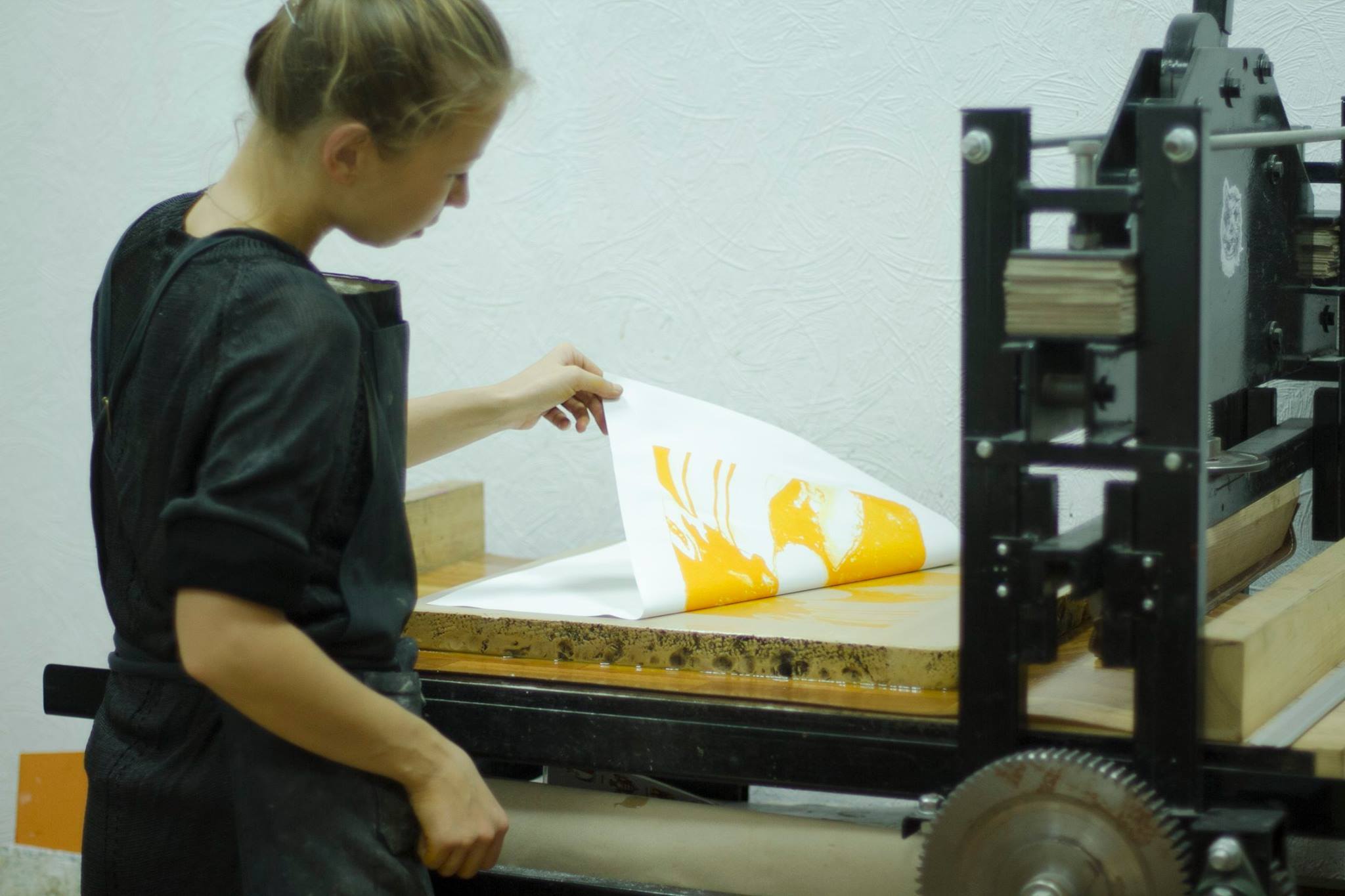
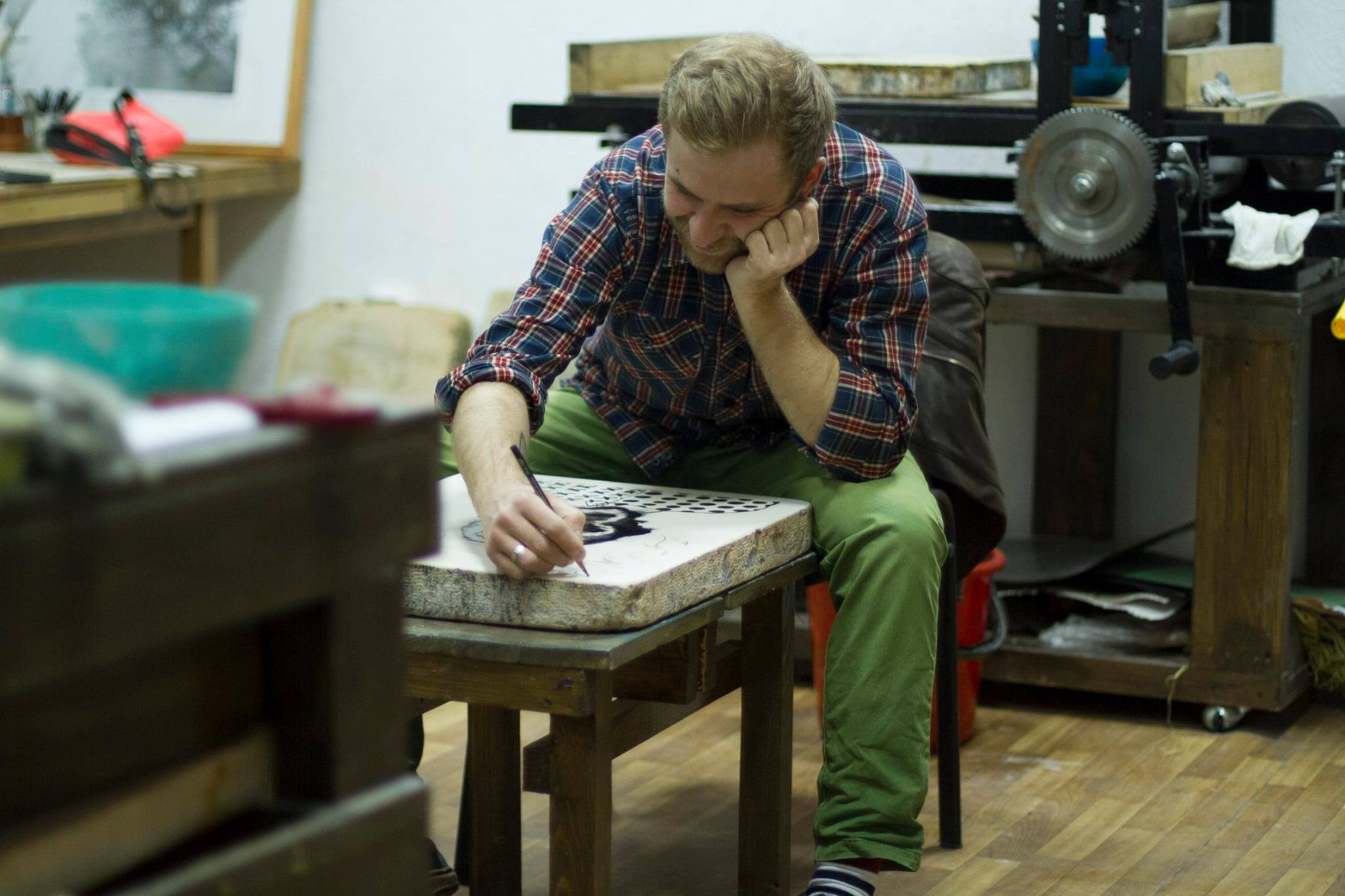
Taras: One has to work on it for about three months to develop automatic skills. In short, a stone must be ground first before an image is applied on it. You take one stone, spray it with sand and water, put another stone on top and chafe it on a special grinding table for an hour and half until stones become even, smooth and degreased. Then an image is created on stone with lithographic ink or a pencil.
Big advantage of this technique is that you clearly see the final print. All washings, textures.
Nina: By comparison, in etching one has to make a proof impression. And in lithography you see everything at once, well, ideally.
Taras: After that the image is treated with dextrin and some nitric acid, surface with the image on it remains greasy, and empty surface is degreased.
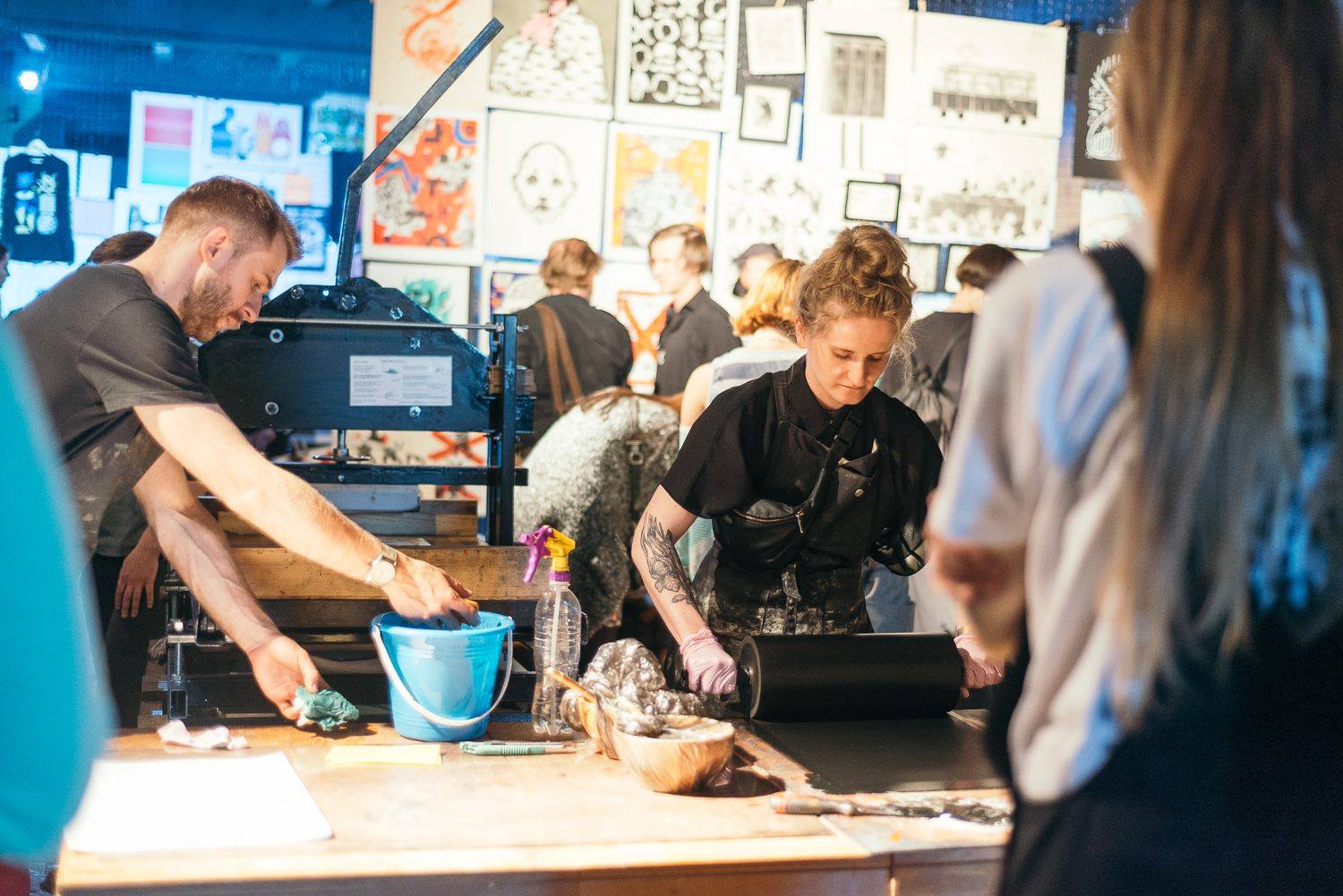
Paint is then applied and the image is printed on the lithographic press. The feature of this technique is that you need water constantly. Stone is moistened, it is wet, image is applied with a greasy ink and paint is greasy. Greasy stuff sticks to greasy stuff and by changing quantity of applied grease you can create colour gradation.
In etching printing is done from the depth of creases, in linoleum engraving – upper surface, white is cut out, and in lithography – absolutely flat surface and “grease or water” principle. Stone is moistened every time before printing, paint is applied and an impression is made.
For colour works you need as many stones as you have colours. One colour, then grinding, then another colour, then more grinding.
So how can one find one’s range?
Alisa: Lithography is a complex technique, so such questions are common, but everything is possible.
Taras: Yes, painting is quick and great, but printing is not. Many painters did lithography, but few did printing, because one needs experience for that.
Nina: When I wanted to learn printing, I stood behind Taras’ back for half a year and moistened stones. Then I wrote down all the steps on a piece of paper for another half a year.
Theory in lithography is very subtle, especially in our makeshift environment when half of materials have to be replaced with something else. Everything is created based on touch and intuition. And the result is often different.
Taras: Every lithography studio operates in its own way, including or excluding certain processes.
Alisa: Even in our studio everyone uses its own way of printing. For instance, Nina likes a lot of paint, black colour.
Nina: Yes, and Alisa prefers colour gradation.
Ok, so you create a page on Facebook, and then what?
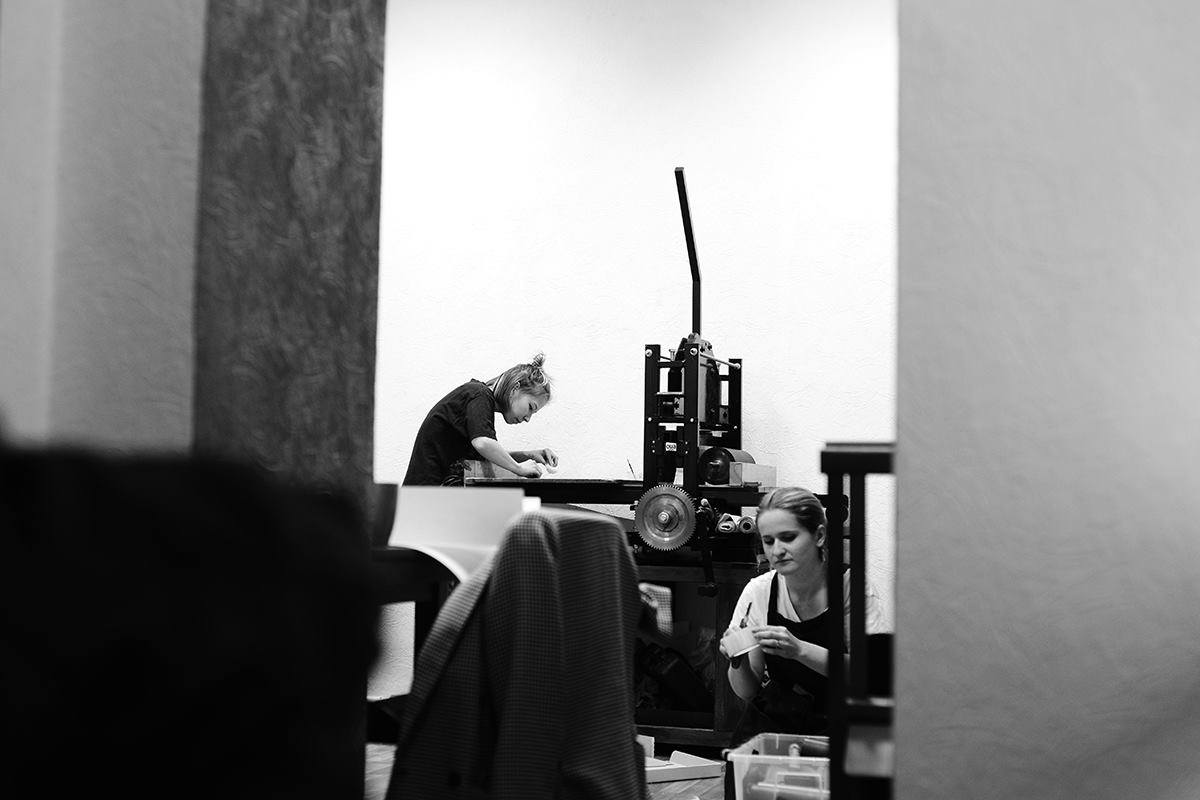
Nina: We did not have a studio. We just did lithography. We worked in a room No. 30, hence Litografskaya 30. We did our first exhibition displaying 30 works, and we liked everything a lot. After that there was a long break. We left the institute. Later on we rented premises (24 sq. m) with a bucket and an easel instead of the fourth chair. And we faced the challenge: there were no materials.
Taras: Nina and I went to Lviv, visited academicians, called institutes.
Alisa: I remember I once called a famous artist and he said “there was a press in the Artists’ Union, but it was moved to the Printing Institute”. The very same that we left.
Nina: Demand for an etching press has arisen recently. They started to make them near Kharkiv. So it’s not like it used to be – an artist dies and his press passes to another artist. Anyway, there we were in our first studio with a bucket instead of the fourth chair. Later on a small etching press appeared. It was my New Year’s present from Taras. Then guys from IZOLYATSIYA came into scene and we started to cooperate with them. At some point we got tired of master classes, moved to our current premises, found stones for lithography and got to work.
Taras: After doing lithography for year and a half we arranged our first exhibition. We had to recollect everything, to start thinking on a project scale.
Alisa: You have to like each process here, even grinding.
Nina: Maybe one has to have a character for lithography. If you need 5 colours in your work you grind the stone 5 times. It is meditation. A friend of mine said once, “Whenever I come to visit Nina she is always grinding. Does she do anything else?”
Alisa: Sometimes when you have been out of the studio for long, nothing comes out right. You know everything but it seems lithography got a grudge against you for being away for so long.
Nina: This is our private joke: first you must take lithography to the movies, buy it an ice-cream, find an approach.
Do people in Ukraine understand what lithography is?
Taras: It is getting better.
Last year people at the festival asked us why we couldn’t use a printer for that. So we had to explain that in printing there were only 1,200 dots, and in lithography dots in an image are endless.
That’s what amazes people. And at the same festival this year we weren’t asked such questions.
Nina: Such events as PrintFest or Book Arsenal make people ask themselves questions. In western countries everyone knows about lithography, there are dozens of such studios in cities there.
Do you work separately, or do you have joint works?
Nina: Our single joint work is on the wall over there. We would like to continue it as a series.
Taras: Common title is Son of Three, but among ourselves we call is Hellish Vasya.
What is your target audience?
Nina: People who took a fancy to it and they can’t live without this work, or people who buy it for business – for public spaces.
Alisa: Recently, a DJ bought my work for his album cover.
Colour or monochrome?
Taras: I am in charge of colour here, all colour works on the walls are mine.
Nina: When I decided to work with the black colour only, I realized that it was even more difficult because you have to think holistically. If you fail to do something with one colour you can improve it with other colours, but this is not my case.
Taras: Now we use the technique for our purposes, and it was the other way round before.
Nina: Today our means coincide with our wishes.
Alisa: I had to make four 3-coloured works to understand that for the moment I was happy with red and black and didn’t need other colours.
Please tell about your cooperation with BURSA Hotel.
Alisa: Each of us will have 4 works displayed at the hotel. This is a pleasant feeling that our works will “reside” not only at exhibitions and in our studio. People in BURSA will be unprepared and exposed to lithographs by chance.
Taras: This is great that such art, Ukrainian but not conventional, will be available for most people.
Nina: So not just woven dolls and painted Easter eggs. Human beings must be forced to ask themselves questions. And how could questions be asked if there is no reason to formulate it in one’s head?
What is art for you in one word?
Alisa: Art is life.
Nina: Yes, it may sound cliché, but it is true. Especially in our case.
Taras: Let it be process.